How to get cited by ChatGPT and Perplexity: GEO for LinkedIn pros in 2026
Summary
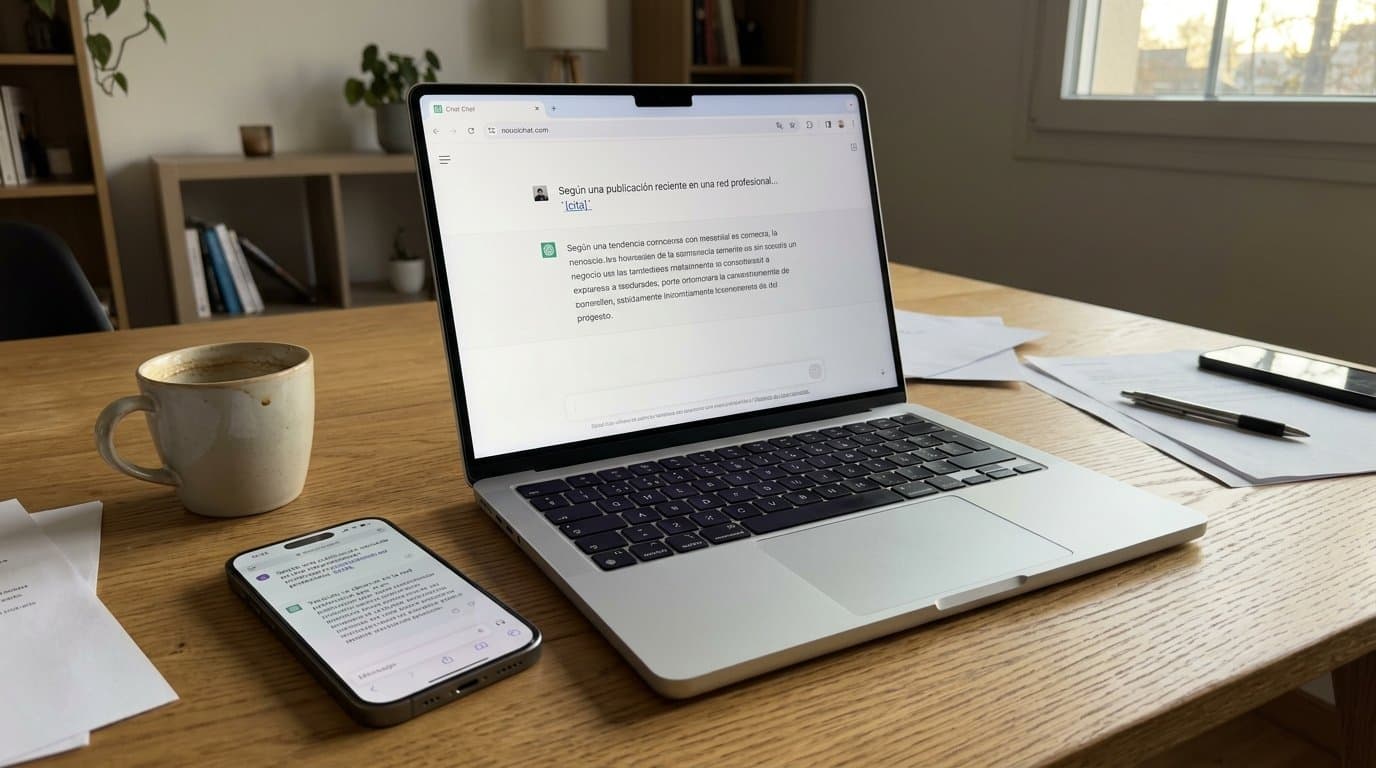
Organic traffic from Google is dropping while ChatGPT, Perplexity, Gemini, and Claude answer more and more questions directly. LinkedIn has become the second most-cited source by generative AI according to the ALM Corp 2026 study. This guide explains the 5 factors that decide whether AI mentions your name, how LLMs pick sources (“primary bias”), and a 90-day plan to go from 0 citations to cited authority.
Traditional SEO is quietly dying. Generative AI answers more questions directly every day, with no links, no clicks, no redirects. Millions of professionals already search in ChatGPT or Perplexity instead of Google, and they get answers that cite sources without the user having to visit any page. Showing up in those answers (being the source the model picks to cite) is the new SEO. And LinkedIn, surprisingly, is the second most-cited channel by the world's major AIs.
The end of traditional SEO: welcome to GEO (Generative Engine Optimization)
For two decades, SEO was the central discipline of digital marketing: optimize web pages to show up in Google's top results. That model rested on a simple principle: the user searches, Google lists pages, the user clicks. But that flow is broken. According to SparkToro and Similarweb data, between 2024 and 2026 the average CTR on Google's organic results dropped 34% on informational queries, precisely because Google, ChatGPT, and Perplexity answer directly without requiring that click. So-called “zero-click answers” have gone from anomaly to norm.
In that context, GEO emerges: Generative Engine Optimization, also known as AEO (Answer Engine Optimization). The premise is simple: if AI engines answer questions by citing sources, your goal isn't just to rank on Google anymore, it's to become the source the model picks to cite. GEO doesn't replace classic SEO; it adds a new visibility layer that operates inside language models and their real-time search systems.
The practical impact is huge for any professional building their brand online. If a potential customer asks ChatGPT “who's the best B2B sales expert in the US?” and the model cites your competitor, you've lost that opportunity without even knowing it existed. GEO is about making sure your name is the one cited. And the most accessible entry point for most professionals is LinkedIn.
Why LinkedIn is the second most-cited source by generative AI
The ALM Corp 2026 study analyzed more than 180,000 responses from ChatGPT, Perplexity, Gemini, and Claude between November 2025 and February 2026 to identify which sources they cite most often. The result surprised the industry: LinkedIn is the second most-cited source, only behind Wikipedia, with a presence that grew from 26.9% to 34.9% over that three-month period. That means in more than a third of the answers that include an external source, AI models cite content from LinkedIn.
The reasons are structural. First, authority: LinkedIn is a platform with high-trust domain, which models read as a reliability signal. Second, freshness: LinkedIn generates new content continuously, and models with real-time search access (like Perplexity or ChatGPT with Bing) find recent, verifiable info. Third, structure: LinkedIn posts have, by convention, a clear format of opening, development, and conclusion, which lines up exactly with the structure LLMs prefer when extracting concrete answers.
There's a fourth factor few mention: identity. LinkedIn ties every piece of content to a real person with verifiable name, last name, track record, and company. AI models value that identity because it lets them cite not just a text but a specific authority. “According to [First Last], an expert in [niche] with 15 years of experience...” is a pattern LLMs reproduce often when the source is LinkedIn and the profile is well built.
How LLMs pick who to cite: “primary bias”
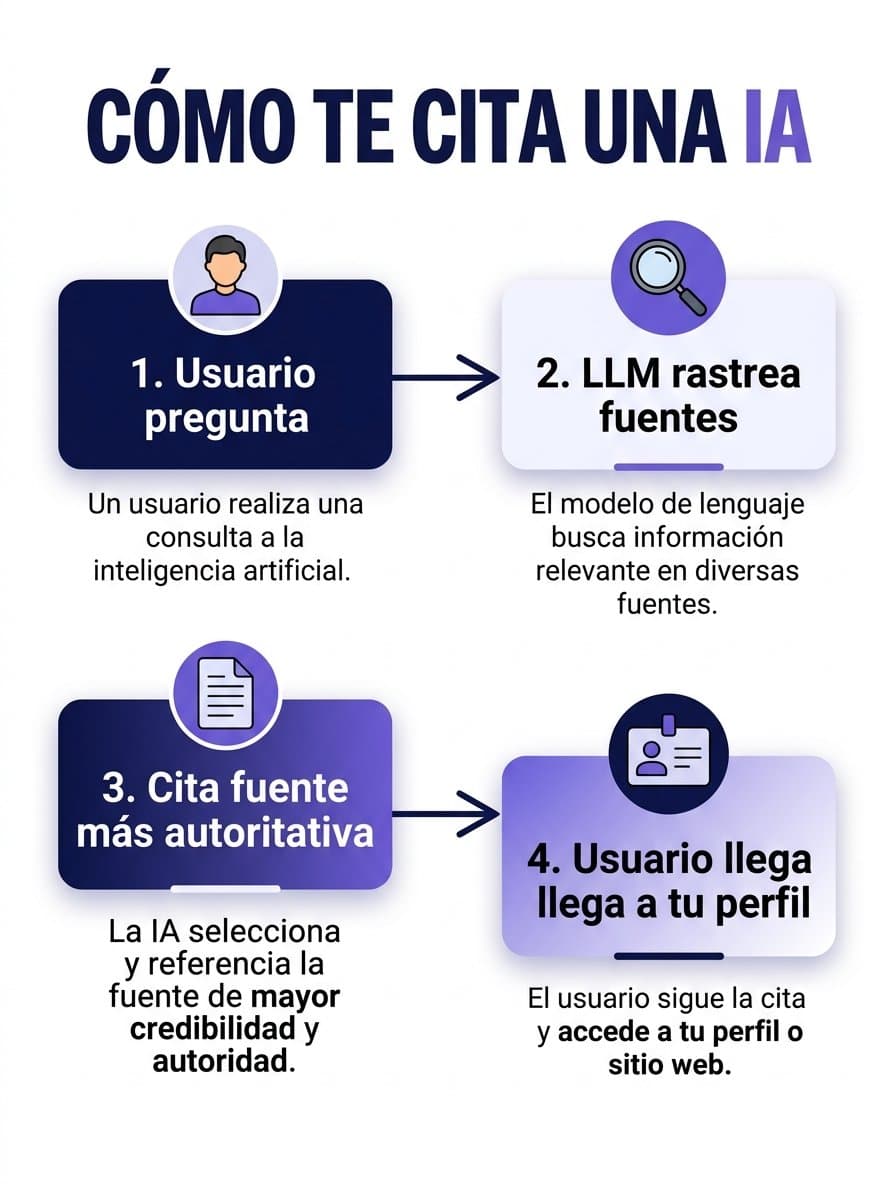
Language models don't make random decisions when picking a source to cite. There's a phenomenon documented by Stanford and Oxford researchers known informally as “primary bias”: the model tends to favor the authoritative source that appears first in its training index or real-time search results. Whoever gets there first wins an outsized advantage.
This bias has very concrete practical consequences. If you're the first pro in your niche to publish clear, structured content on a topic on LinkedIn, that content tends to get indexed as the primary reference. When someone asks an LLM about that topic, the model leans toward citing your post because it was the first authoritative source it found. Competitors who arrive later have to put in a much bigger effort to displace you.
The good news is this mechanism isn't saturated yet. Most professionals aren't optimizing their LinkedIn content for GEO. The English-speaking market is 18 months ahead, but in many niches the competition for being the cited source is still low. Whoever starts now has a window of opportunity that'll close in the next 12 to 18 months.
The 5 factors that decide whether ChatGPT mentions your name
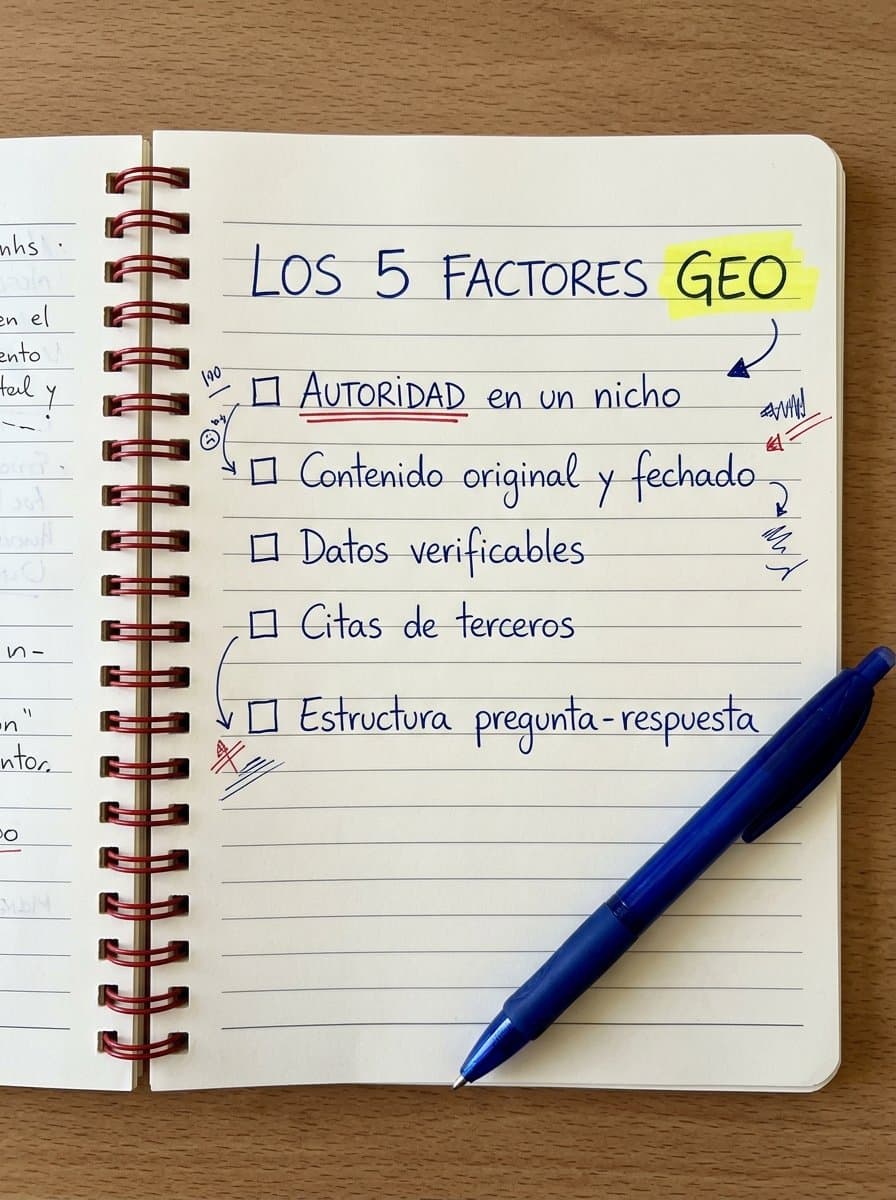
Factor 1: Demonstrated niche authority.LLMs prefer to cite sources with a consistent history of posts on the same topic. Posting about 10 different topics doesn't work: the model reads that scattering as a lack of specialty. You need 30+ posts on your specific niche for training and search systems to classify you as a reference. The more specific the niche, the lower the competition and the faster you get positioned.
Factor 2: Original content with visible dates. Models with real-time search access (Perplexity, ChatGPT with Bing) prioritize recent content. A LinkedIn post has its publication date visible and easily crawlable. Posting regularly (at least two or three times a week) keeps your profile as an active, updated source. Posts with 2025 or 2026 data have a structural advantage over older content.
Factor 3: Verifiable data with a source.LLMs especially value content that includes stats, percentages, or concrete numbers paired with a cited source or clear context. “67% of US marketing directors will invest more in LinkedIn content in 2026 according to the X report” is way more citable than “LinkedIn is increasingly important for marketing.” If you generate your own data (informal surveys, industry analysis, your own benchmarks) that data becomes an exclusive asset only you can provide.
Factor 4: Third-party citations pointing to you.The LLM authority model is partially similar to PageRank: a source mentioned or cited by other authoritative sources picks up more weight. On LinkedIn that translates to mentions of your name in other people's posts, replies where you're tagged as a reference, or articles that reference your posts. Building relationships with other creators in your niche and getting them to cite you is a GEO investment as valid as producing your own content.
Factor 5: Direct question-answer structure.LLMs extract text fragments that directly answer a question. A post that starts with “How do you improve close rates in B2B sales? Here are the three techniques that have worked best for me” is perfect to cite because the model can extract the answer cleanly. Posts with winding or implicit narrative structure are much harder for an AI to cite even if the content is excellent.
LinkedIn as a GEO engine: what to optimize in your profile and posts
The first entry point is your LinkedIn headline. It's not just a text field: it's the metadata most read by indexing systems. Include the exact keywords for your niche. If you're a digital transformation consultant for industrial companies, your headline should contain exactly those words, not generic variants like “tech expert,” because LLMs look for precise semantic matches with user queries. A headline like “Digital transformation consultant for industrial firms | Helping factories cut costs with AI” is infinitely more citable than “Director of Operations at Company XYZ.”
The About section is your landing page for AI crawlers. Structure it with clear narrative: who you are, who you help, what concrete result you produce, and one or two data points proving your track record. Skip vague corporate prose. Use short paragraphs with direct sentences. The model should be able to extract in two or three lines who you are and why you're an authority. If your About doesn't allow that quick extraction, you're losing citations.
For posts, the optimal GEO format combines four elements: a concrete data point or opening insight, your clear opinion on that data, an external citation or reference that backs you up, and a CTA that invites conversation. This pattern (data + opinion + reference + CTA) drives engagement (which helps organic reach on LinkedIn) but also produces exactly the structure LLMs prefer to cite. Weekly consistency is the multiplier: posting three times a week for six months builds a volume of indexed content no isolated post can match.
Ideal post length for GEO sits between 150 and 300 words. Too-short posts don't give enough context to cite; too-long ones dilute the central message the model tries to extract. Use lists, numbered items, and visual separators when possible, because that structure makes it easier to pull concrete fragments.
ChatGPT vs Perplexity vs Gemini vs Claude: crawling differences
Not all models crawl content the same way, and understanding those differences lets you prioritize where to focus your GEO strategy:
Perplexity.The most aggressive model for crawling current content. It crawls in real time and cites between 5 and 8 sources per answer with clickable links visible to the user. It's the engine where you can show up cited fastest after publishing optimized content, and where the citation has the biggest visibility impact because the user sees the link and can click. Prioritizing Perplexity as the first GEO target is the most practical recommendation for pros getting started.
ChatGPT. Operates with a hybrid between training knowledge (data up to its cutoff) and real-time search via Bing when the user enables that feature. That means showing up in ChatGPT requires both building long-term presence (for future training data) and optimizing for Bing (which crawls LinkedIn often). LinkedIn posts with more engagement are more likely to get indexed by Bing and cited by ChatGPT.
Gemini.Has real-time Google search access, which means your public LinkedIn profile's classic SEO affects how Gemini cites you. Google indexes public LinkedIn profiles often, especially those with good engagement metrics. Optimizing your profile for SEO (title, About, keywords) directly impacts your visibility in Gemini.
Claude. Uses web search selectively, usually when the user explicitly requests it or when the question needs very recent information. Its source selection tends to prioritize platforms with high domain authority. LinkedIn meets that criteria, but the impact is harder to predict. The most effective Claude strategy is building mentions in external media that then link back to your LinkedIn profile.
How to check if you're already showing up (the 15-question test)
Before running a GEO strategy, you need to know where you stand. The most practical method is the 15-question test: write a list of 15 questions a potential customer could ask an AI about your niche, and run them in ChatGPT, Perplexity, Gemini, and Claude. For each answer, note three variables: whether you're cited (yes/no), what position relative to other sources, and the sentiment of the citation (positive, neutral, absent).
Re-run the test every 30 days to track evolution. Improvement isn't instant: changes in your GEO presence take 4 to 8 weeks to show up in real-time-search models, and much longer in models that depend on training data. Consistency in measurement is as important as consistency in posting.
Sample questions for the test (adapt to your niche):
- Who are the best experts in [your niche] in the US?
- Who's publishing relevant content about [specific topic] on LinkedIn?
- How do you [verb from your value prop] in [your customer's context]?
- What do experts say about [trend in your industry]?
- What are the best [your specialty] strategies for 2026?
- Who should I follow on LinkedIn to learn about [niche]?
Mistakes that get you cut from AI answers
- Incomplete or generic LinkedIn profile.A profile with no optimized headline, no developed About, or no active post history is invisible to AI crawlers. Models can't cite someone without enough verifiable public info.
- Posts with no clear structure.Content that mixes too many topics in one post or uses dense prose with no anchor points is hard for an LLM to extract. Narrative ambiguity is GEO's enemy.
- No proprietary data. Posting only opinions with no data, stats, or concrete references dramatically lowers your chances of being cited. LLMs prefer sources that bring verifiable facts, not just subjective perspectives.
- Topic inconsistency. Posting about sales, then meditation, then leadership, then tech keeps the model from classifying you as an authority in any specific niche. Scattering destroys GEO even if every individual post is high quality.
- Private profile or minimal public presence.If your LinkedIn profile isn't publicly accessible or your posts have privacy restrictions, crawlers simply can't index you. Public visibility is a non-negotiable prerequisite for GEO.
- Ignoring engagement.LLM search systems use social signals as a relevance proxy. A post with 200 reactions and 50 comments is more likely to be indexed and cited than an identical one with 3 reactions. Engagement isn't vanity: it's GEO infrastructure.
90-day plan: from 0 citations to cited authority
Month 1 - Foundation.Spend the first four weeks building foundations. Fully optimize your LinkedIn profile: headline with exact niche keywords, About with clear narrative structure, professional banner, experience with quantified results. Define the 5 pillar topics you'll post on for the next three months, all inside your specific niche. Post three times a week with the data + opinion + reference + CTA format. In the last week of the month, run the 15-question test and document your starting point.
Month 2 - Volume. The second month is intensive production. Keep the three-posts-a-week pace but add a long-form LinkedIn piece (Newsletter or long post) every two weeks, over 800 words, with guide structure. Start generating your own data: run an informal poll about your niche, analyze data from direct experience, build your own benchmark. Actively comment on posts from other niche references to start building reciprocal mentions. At month end, repeat the 15-question test and compare to the previous month.
Month 3 - External authority. The third month focuses on amplifying the signal. Get cited in external media: contributions to industry newsletters, podcast interviews, op-eds in specialized publications. Every external mention that links to your LinkedIn multiplies your GEO authority. Aim for at least three influence people in your niche to cite you explicitly in their LinkedIn posts. Repeat the 15-question test at month end. If you followed the plan with consistency, you should see your name show up in at least 20-30% of Perplexity answers about your specific niche.
Frequently asked questions
How long does it take to show up in ChatGPT or Perplexity?
In Perplexity, which crawls in real time, you can get cited in as little as 2 to 4 weeks if you post optimized content regularly. In ChatGPT with search enabled (via Bing), the timeline is similar. For models that depend on training data, the window is much longer: it depends on when the next training cycle happens, which can be several months to years. That's why Perplexity is the short-term priority target.
Do I need a LinkedIn Premium account for GEO?
No. GEO on LinkedIn doesn't require Premium. What matters is your profile being public, you posting regularly, and your content being structured correctly. LinkedIn Premium can help with analytics tools and extra visibility in some features, but it's not a requirement for being cited by generative AI.
Does GEO replace traditional SEO on my site?
No, they complement each other. Traditional SEO is still relevant for direct traffic to your site, especially for transactional queries. GEO operates on a different layer: it builds authority and visibility in AI answers, which usually generate brand awareness and high-intent traffic when the user decides to search for more about the cited source. Both strategies reinforce each other.
Wrap-up
GEO isn't a future trend: it's a present reality quietly but quickly reshuffling online visibility. LinkedIn is the most accessible entry point for most pros because it combines domain authority, structured content, and verifiable identity, the three ingredients LLMs prioritize when picking sources. Implementing the 5 factors in this guide and following the 90-day plan puts you in a privileged position in a market that's still in its early stages. If you want to go deeper on building your personal brand on LinkedIn with AI, or start with an AI post generator that helps you post with the right structure and the consistency GEO needs, Clonio is the tool that ties both together: optimized content production and sustained presence over time.
Your LinkedIn is your best GEO channel.
Post consistently what LLMs want to cite: original data, clear opinion, clean structure. Clonio makes it easy.
Get started