How to write LinkedIn posts that sound human, not AI (2026 guide)
Summary
90% of recruiters use AI to scan profiles in 2026, and generated-text detectors keep getting better. Copy-pasting from ChatGPT isn't viable on LinkedIn anymore: the algorithm penalizes you, and recruiters drop you. This guide covers the 7 tells of an AI post, how detectors trick (and fail), and 10 concrete techniques to write in your own voice.
Recruiters, hiring managers, and the LinkedIn algorithm itself use detection systems to flag automatically generated text. A post that sounds like ChatGPT doesn't just lose credibility, it can cost you a job opportunity before anyone actually reads you. The solution isn't to stop using AI: it's learning to use it in a way that keeps your voice in the lead.
90% of recruiters use AI to scan text
According to a report published in March 2026, 90% of recruiters at large companies already use AI detection tools as part of their selection process. They don't do it to punish technology use in itself: they do it because text that anyone could have written tells them nothing about you. If your profile and posts sound identical to a thousand other people's, you stop existing on their radar.
The LinkedIn algorithm has evolved too. Since late 2025, the platform has been systematically reducing organic reach for posts that show patterns typical of generated text: overly symmetric structure, no personal specificity, no opinion. Generic copy-paste no longer works: it directly hits your distribution, and if it reaches a selection process it can drop you before anyone reviews your resume.
The problem isn't using AI. The problem is using AI badly. The professionals making the best use of AI in 2026 don't use it to write posts from scratch: they use it to polish ideas they already had, structure arguments they'd already thought through, or speed up editing a draft that was already theirs. The result sounds like them, not like a machine.
The 7 tells of an AI-written post
1. Openers like "In today's landscape..."
The first words of a post are the most important. And language models have an irresistible tendency to open with phrases that frame the context in a grand but empty way. "In today's dynamic business leadership landscape..." or "In an increasingly digital world..." are the textual equivalent of a fanfare announcing nothing. No real person opens a conversation that way.
2. Chains of -ing verbs
The -ing form is the favorite crutch of generated text. "By working as a team, learning from mistakes, and building a growth mindset, we can reach our goals." A chain of three -ing forms in a row is an almost foolproof signal that nobody hand-edited the text. Humans tend to cut sentences. AI tends to chain them.
3. Bullets with perfect parallel structure in 3 or 5 points
Language models love lists. Specifically, lists of three or five items where each point has exactly the same grammatical structure. "1. Active listening. 2. Assertive communication. 3. Genuine empathy." Perfect symmetry looks nice on paper, but on LinkedIn it reads as a template. Real lists have uneven points, some shorter, one that breaks the pattern.
4. No concrete opinion
AI-generated text tends toward consensus. It states things nobody would dispute, avoids taking positions, and ends on a safe note that bothers no one. "Effective leadership requires balancing results and people." True. And completely inert. A post nobody could disagree with also says nothing memorable.
5. Stacked adjectives without substance
"A robust, scalable, and disruptive solution."Those three adjectives together are the signature of generated corporate text. They show up because models learn from a lot of enterprise marketing content, and that language inflates words until they're empty of meaning. When you see "robust," "scalable," or "disruptive" together in a LinkedIn post, the detector is already beeping.
6. Closing with a neutral open question
"What's your take on this topic? I love reading your thoughts in the comments." This closing, or any variation on it, is a classic symptom of generated text optimized for mechanical engagement. The question is so generic that it invites no real answer. A human close has a position, a concrete provocation, or simply ends when the argument ends.
7. Same problem-solution-call structure post after post
One post with a problem-solution-CTA structure can work perfectly. The problem shows up when every one of your posts has exactly that same structure, with the same length, the same blocks, and the same tone. Total uniformity is a signal that nobody is making real editorial decisions: it's the AI repeating its favorite template.
How detectors trick (and fail): GPTZero, ZeroGPT, Copyleaks
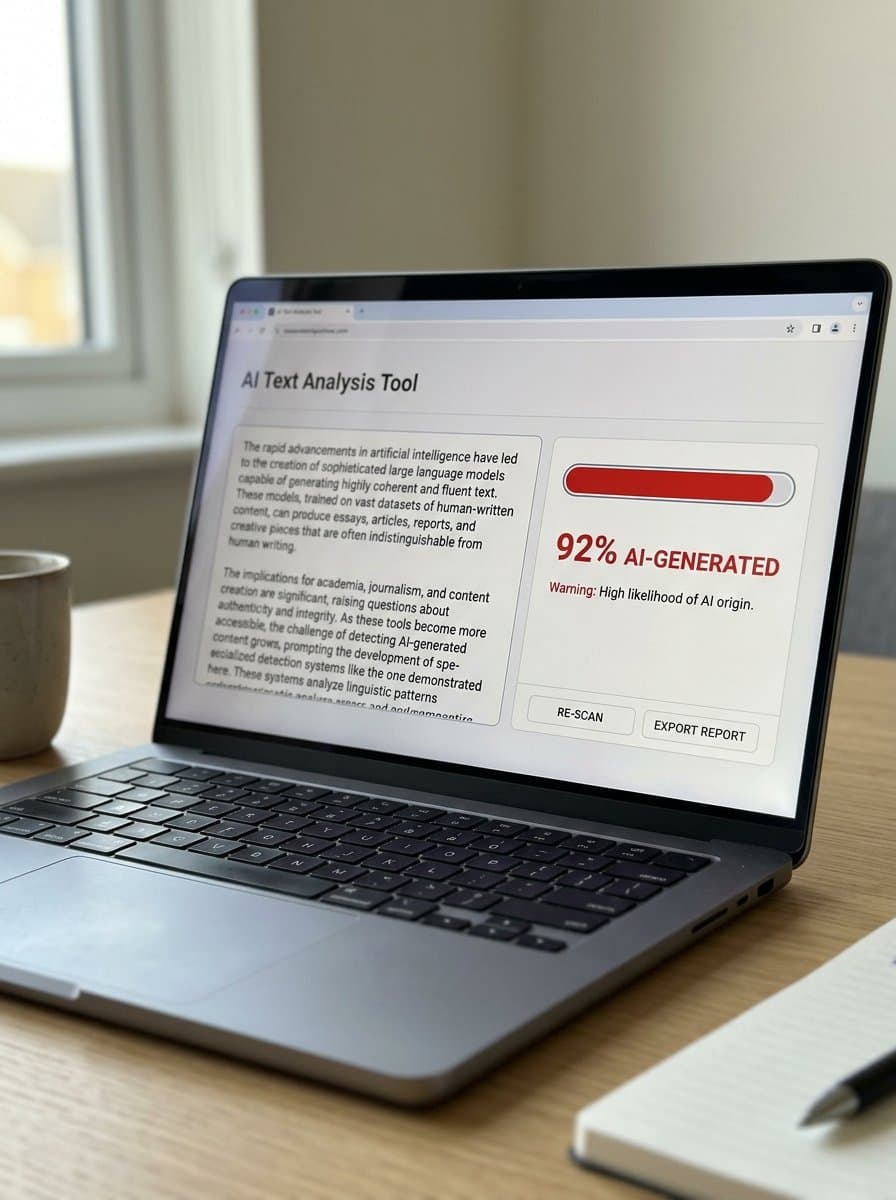
The most widely used AI detectors, GPTZero, ZeroGPT, and Copyleaks, work by measuring two main variables: perplexity (how predictable each sentence is within the text) and burstiness (how much sentence length and complexity vary). Humans write with high variability: short sentences followed by long ones, rhythm changes, unexpected breaks. AI tends to produce uniform, predictable, metrically consistent text.
But these detectors have important limits. They systematically fail on short texts: a 150-word post doesn't provide enough statistical sample for the detector to be reliable, and false positives spike. They also fail on naturally uniform writers: some people have a clear, consistent, controlled style that a detector can wrongly classify as AI even though every word is theirs. GPTZero has publicly admitted error rates that make its verdicts unreliable on short texts.
The problem is that people keep using them anyway. A recruiter who gets 300 applications in three days doesn't have time to read each profile carefully. If a tool says "possibly AI generated," that candidate is dropped even if the verdict is wrong. The fight isn't just against the detector: it's against perception. And that requires your text to pass both human and automated scrutiny.
The "3 layers" framework: own facts + voice + human imperfection
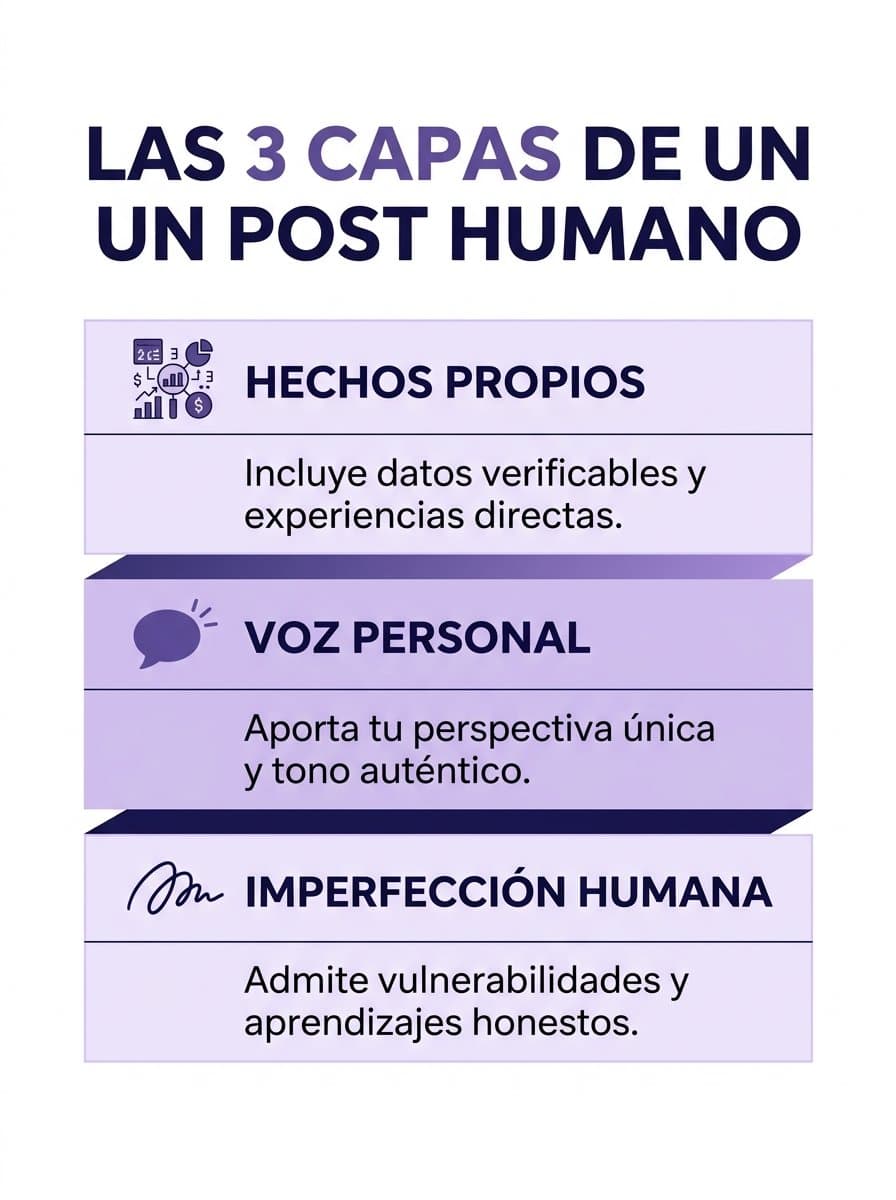
Layer 1, own facts.Language models don't know that last Tuesday you had a meeting with a client in Boston that made you rethink your whole pitch. They don't know your conversion rate dropped 12% in February and what you did to recover it. They don't know what exactly happened on the project you shipped in October. That specificity, a data point only you know, a real name, a true number, a concrete place, is what no AI can invent for you and what makes a post irreplaceable.
Layer 2, voice.We all have verbal tics, rhythms, ways of opening a sentence. Some people always use colons for emphasis. Others start paragraphs with "And." Others break sentences at the least expected moment. Those quirks aren't mistakes: they're the fingerprint of your writing. Identifying them and using them consciously is what makes your posts sound like you even when you've used AI to structure them.
Layer 3, imperfection.No human writes in a perfectly parallel, perfectly balanced, perfectly polished way. A comma slightly out of place, a sentence that cuts off before finishing, parentheses adding a marginal comment, an aside that interrupts the flow, those imperfections are signs that a real person was thinking while writing. It's not about making mistakes on purpose: it's about not polishing so much that the text loses all human texture.
10 humanization techniques that work today
These are the techniques with the biggest impact in 2026. They aren't tricks for fooling detectors: they're about writing in a way that actually sounds like a real person with something concrete to say.
- Use real proper names.Instead of "a client," write "Maria, head of operations at a logistics company in Austin." The level of specificity signals authenticity instantly.
- Anchor the post to a concrete date or place."Last Thursday, walking out of a meeting in SoMa..." creates a context no AI could fabricate because it's yours.
- Allow small intentional roughness. A comma before a conjunction, a sentence ending on a preposition. Humans write like that. Detectors know it.
- Mix in 4-to-6-word sentences.They break rhythm. They create impact. They always work. AI leans toward long sentences; you don't have to.
- Open with a concrete action, not a concept.Instead of "Leadership is essential...," write "Yesterday I canceled a two-hour meeting." A past-tense action grabs attention because it implies something happened.
- Drop in an unpopular opinion.Something a part of your audience might disagree with. AI avoids conflict; you don't have to. Controlled controversy generates more real engagement than safe consensus.
- Tell a micro-anecdote.Two or three sentences about something that actually happened. It doesn't have to be epic: it just has to be yours and specific. Real narrative is the biggest differentiator against generated text.
- Use your own metaphor.A comparison you wouldn't find in Google even if you searched. Language models recycle existing metaphors; original ones are the fingerprint of real thinking.
- Cut a paragraph in half with a single comma break."We walked into the meeting with the numbers ready, and walked out without the contract." The pause creates drama and breaks the syntactic uniformity of generated text.
- Sign off with an idiosyncratic phrase.An expression you use in real conversations, one your contacts recognize as yours. If your posts always end the same way, that ending becomes your personal brand. And no AI will have it, because you're the one putting it there.
The red-pen exercise: turn an "AI" post into yours in 5 minutes
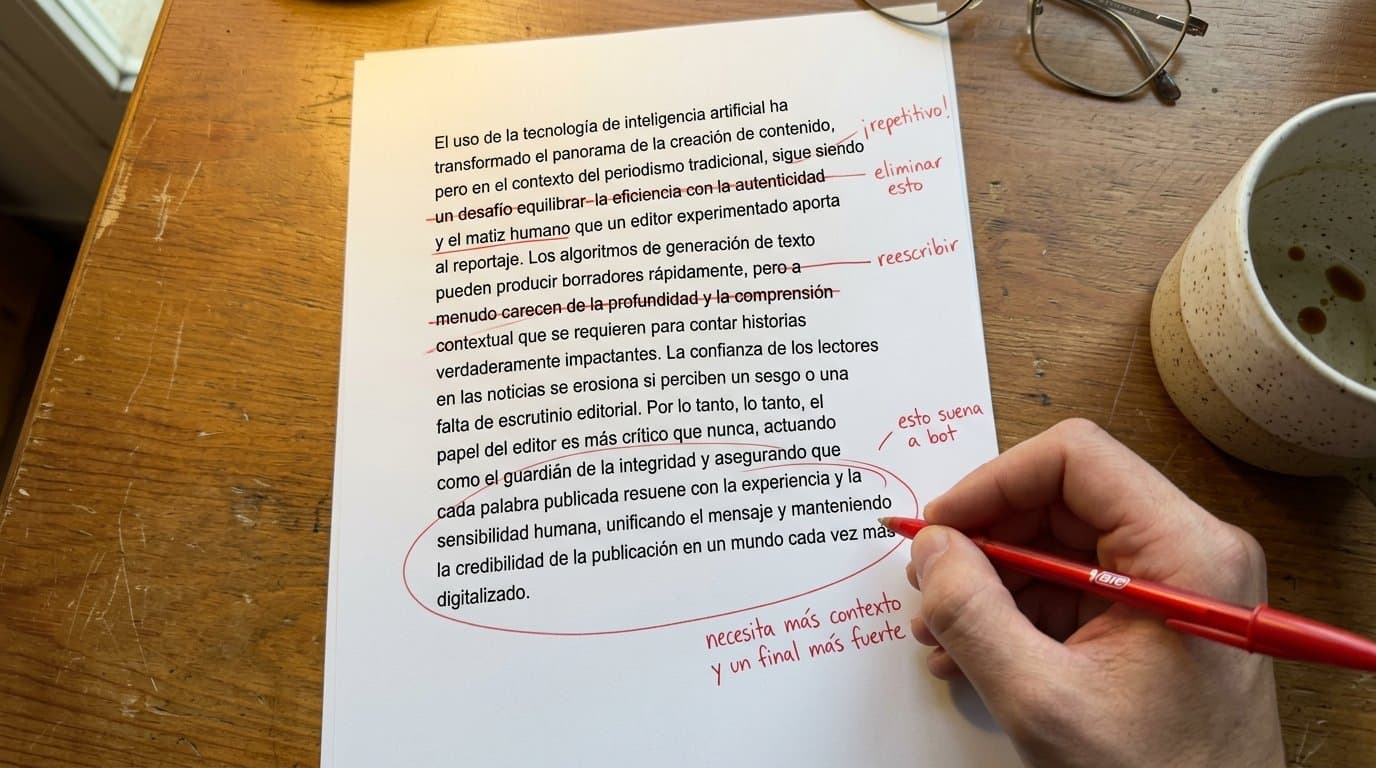
Take any post you've generated with AI and run this exercise. Read each sentence and ask: "Could anyone have written this?" If the answer is yes, underline it in red. Then, for each underlined fragment, add a concrete data point, a real name, or swap the verb for a specific action. The goal is that no generic fragment remains.
Before (AI-generated)
"In today's dynamic landscape, effective leadership requires constant adaptation to changes in the environment. The professionals who stand out are those who combine technical skills with assertive communication and a continuous growth mindset. What's your strategy for leading in times of uncertainty?"
After (humanized)
"On Monday I let someone go who had been on the team for four years. Not because of performance. Because the company couldn't keep the role. It's the part of leading that nobody teaches in management books. 'Assertive communication' doesn't help much when you don't have good news to share. What helps is being honest, fast, and not leaving the other person in doubt about their future."
The change is radical. The first one could have been written by anyone. The second could only have been written by someone who lived that situation. That difference is exactly what readers and recruiters are looking for.
Why Cloniogenerates already-humanized text (and ChatGPT doesn't)
ChatGPT starts from zero every time you ask it for a post. It doesn't know how you write, what verbal tics you use, how long your sentences usually are, or which topics you cover with the most depth. The result is generic text that sounds fine but doesn't sound like you. And on LinkedIn, where personal brand is everything, that's a central problem.
Clonio works differently. Before generating a single post, it learns your voice from your previous LinkedIn posts. It analyzes your sentence rhythm, your usual vocabulary, the topics you cover most often, and how you typically open and close your posts. This voice profile is the foundation for generating every new post.
The result is text that already carries your writing patterns from the first draft. You don't need to rewrite for it to sound like you: it already sounds like you. And that has a direct impact on AI detectors, because the generated text reflects your real style instead of the average voice of the internet.
If you're building your personal brand on LinkedIn with AI, the starting point is exactly this: making sure the text you publish represents your voice, not that of a machine that doesn't know you.
12-point checklist before hitting "publish"
Before publishing any post on LinkedIn, run through this list. If you answer "no" to more than three points, the text needs another round of editing.
- Is there at least one data point only you know (a real number, a name, a concrete date)?
- Is the first line alive? Would someone scrolling stop to read it?
- Is there at least one opinion that might bother someone in your audience?
- Did you use an -ing form more than twice? If yes, remove one.
- Is there a sentence with fewer than six words?
- Is the structure different from your last post?
- Does the closing avoid the generic "what do you think?" question?
- Do any of these words show up: "robust," "scalable," "disruptive," or "dynamic"? If yes, swap them.
- Does the text open with a concrete action or a real situation?
- Is there a metaphor or comparison you wouldn't find in a generic post on the same topic?
- Does the text vary sentence length, or are they all between 15 and 20 words?
- If someone read it without seeing your name, would they recognize it as yours?
FAQ
Are AI detectors reliable?
On long texts (more than 500 words), the most advanced detectors like GPTZero or Copyleaks have reasonable accuracy. On short texts like LinkedIn posts, the error rate rises significantly and false positives are common. Still, that doesn't make them irrelevant: if a recruiter uses them and the result is "possibly AI," the damage is done even if the verdict is wrong.
Can I use ChatGPT without anyone noticing?
Yes, but it takes work. A ChatGPT draft is only the starting point. You need to add own facts, rewrite the openers, break the symmetry of lists, swap generic adjectives, and make sure there's at least one concrete opinion. If you do all that, the result can sound perfectly human. If you publish the draft as is, it's very likely someone will spot it.
Does LinkedIn penalize me for using AI?
LinkedIn doesn't penalize AI use in itself, but it does reduce the reach of content it identifies as generic or low value. The platform prioritizes content that generates real conversations, and unedited generated text tends to drive less genuine interaction. The practical effect is a drop in organic reach that compounds over time if you don't fix the pattern.
Wrapping up
Writing a LinkedIn post that sounds human doesn't mean writing everything by hand or giving up AI. It means AI works for you, with your voice and your data, instead of replacing you with a generic voice that could belong to anyone. The next step after humanizing the text is working on the first line: LinkedIn hooks are what decide whether someone keeps reading or scrolls past. And to understand why the algorithm distributes some posts more than others, the LinkedIn algorithm in 2026 is the read that follows this one.
Generate posts that already sound like you, not ChatGPT.
Clonio learns your voice from your previous posts and writes in your style. No prompts, no copy-paste.
Get started