30 LinkedIn hooks that work in 2026 (with real examples)
Summary
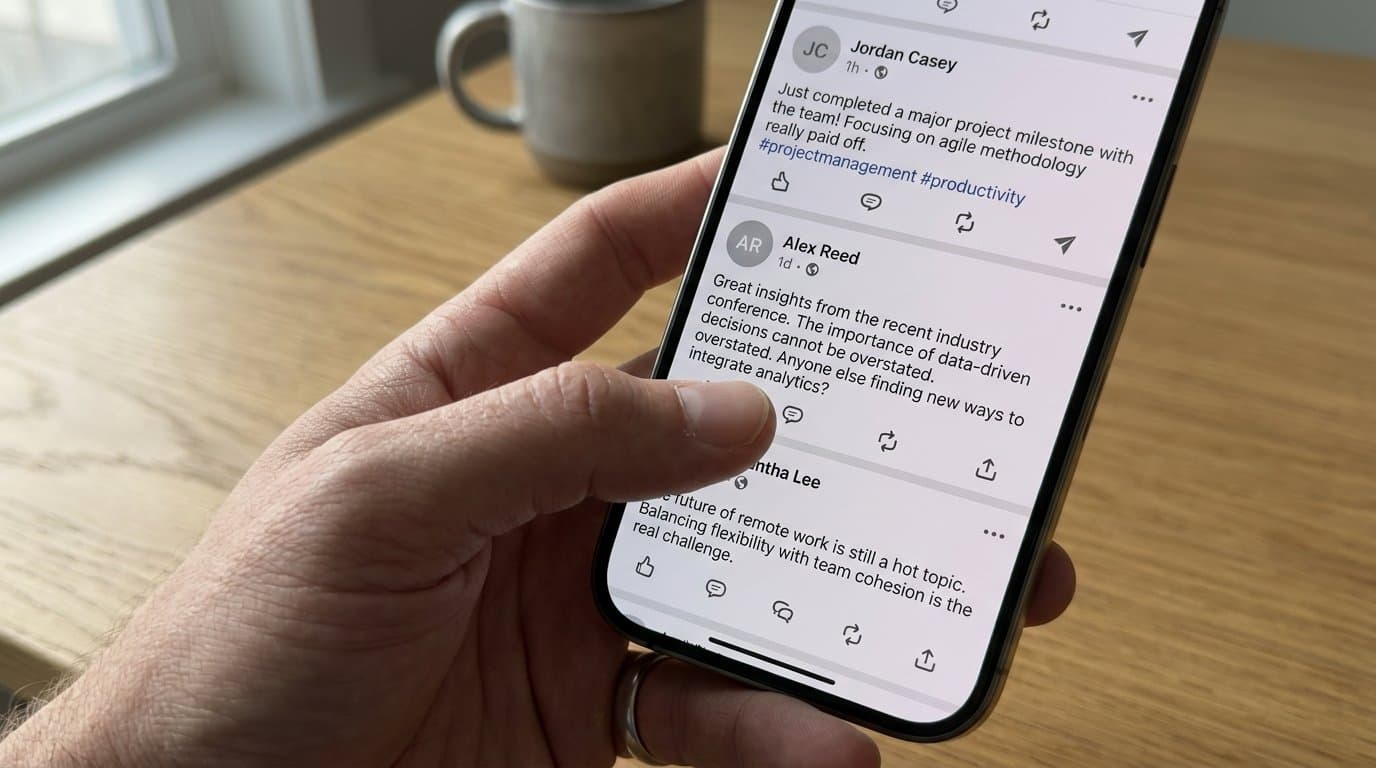
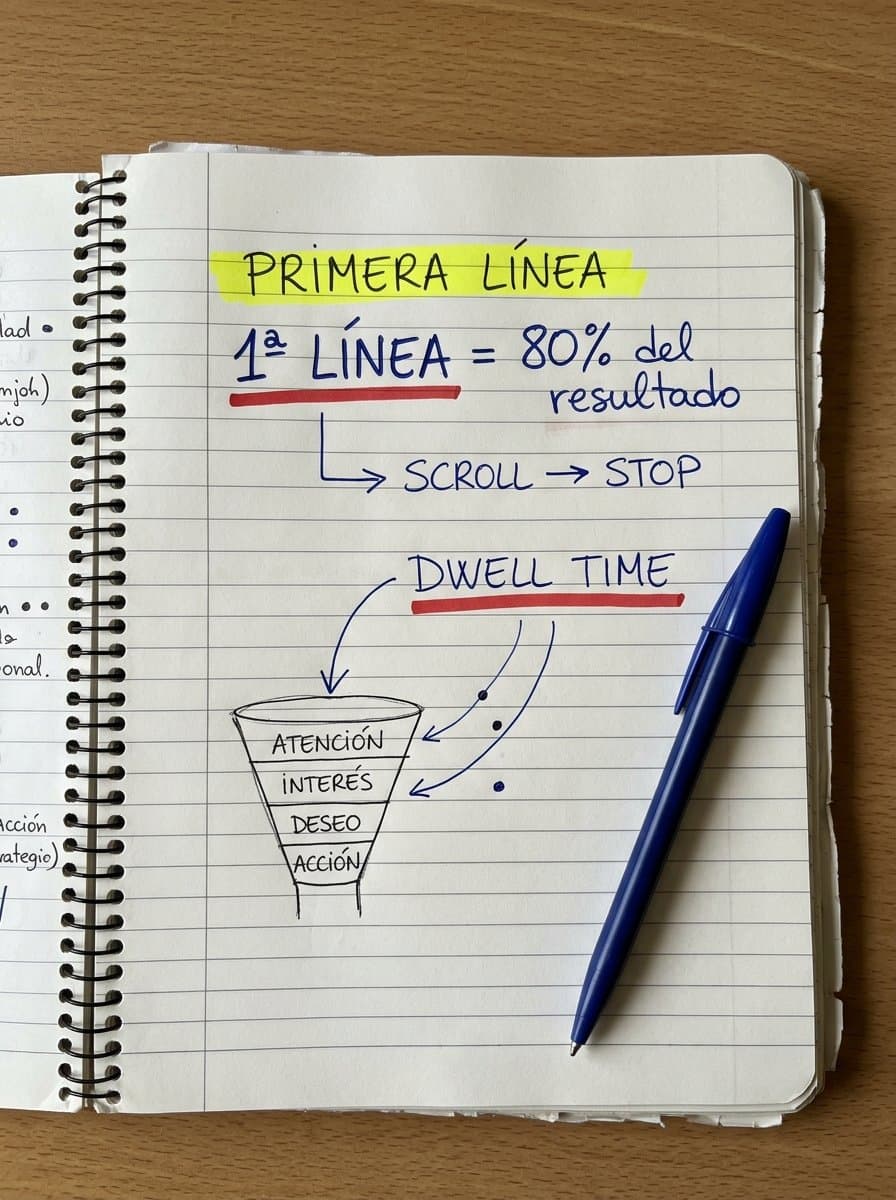
90% of your posts die before line 3 because the hook fails. In 2026, the first line decides 80% of the result: if you don't stop the scroll, the algorithm doesn't distribute. This guide collects the 6 formulas that still work, 30 real examples organized by goal, and the mistakes that kill any post.
On LinkedIn, the first line isn't just important: it's almost everything. The algorithm measures how long someone spends looking at your post before scrolling on, and if that time is minimal, it stops distributing to the rest of your network. Publishing without a strong hook is like setting up a storefront in a dead-end alley: the content exists, but nobody sees it. The good news is that this problem is fully fixable with 6 concrete formulas that let you systematize the first line without relying on momentary inspiration.
Why 90% of your posts die on line 1
LinkedIn isn't a passive social network. It's a competitive distribution platform where every post competes in real time for the attention of people checking the feed during 2 to 5 minute work breaks. In that context, the algorithm prioritizes one metric above all others: dwell time, i.e., the time a user keeps the post visible on screen before moving on. If that time is low, the system reads the content as not worth amplifying and automatically cuts its reach. To go deeper on how this system works, you can read how the algorithm works in 2026.
The first line visible before the "see more" button is what platform experts call zone 1: the only text any user is guaranteed to see. Everything else, the data, the argument, the call to action, stays hidden until someone decides to expand the post. If zone 1 doesn't spark curiosity or instant interest, the rest of the content is effectively invisible.
According to Metricool data for 2026, 50% of a post's total impressions are accumulated in the first 48 hours after publication. That means the initial distribution window is narrow and closes fast. A hook that doesn't land in those first hours condemns the post to a residual reach, because the algorithm uses early signals to decide whether to keep amplifying.
The direct consequence is simple: if nobody gets to the second line, there are no comments, no reactions, no shares. And without those interest signals, the algorithm won't distribute the post beyond a fraction of your followers. The hook isn't an aesthetic detail: it's the entry condition for everything else to work.
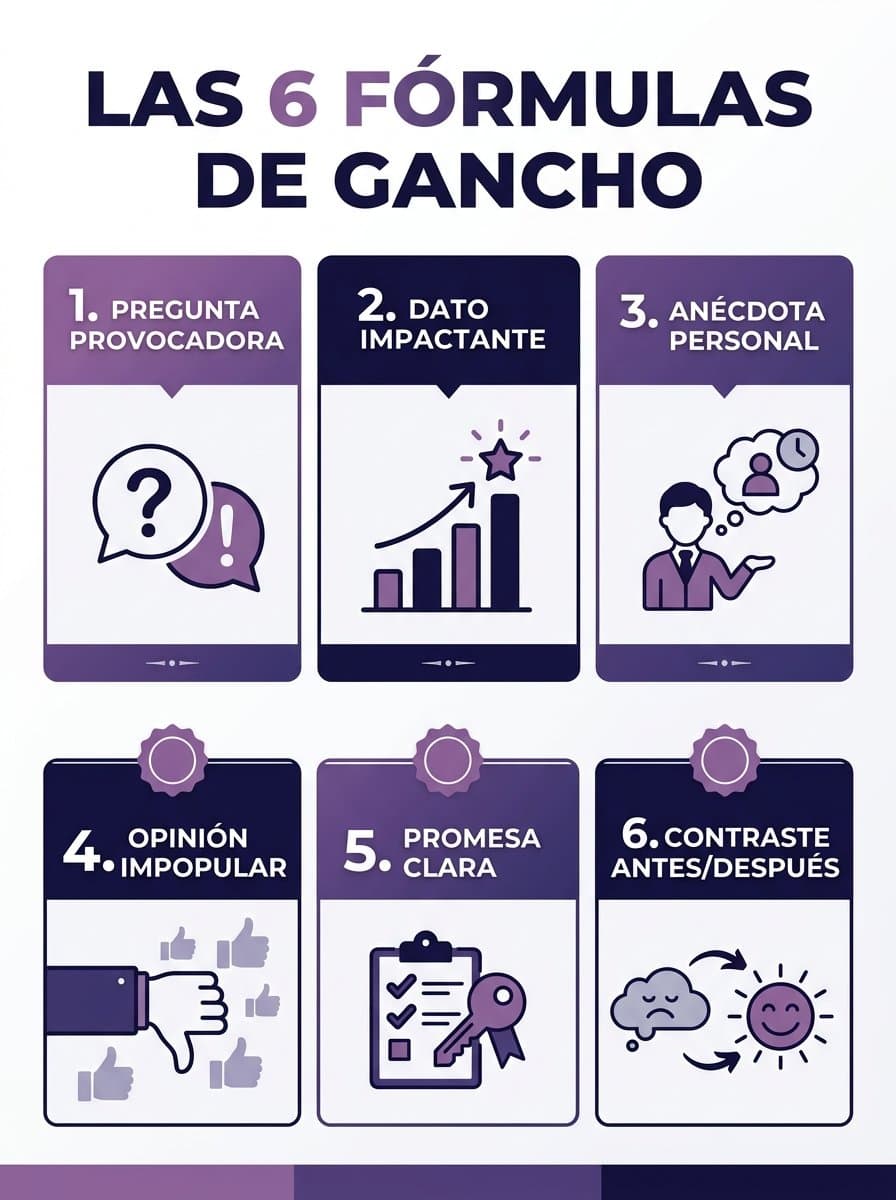
The 6 hook formulas the algorithm rewards in 2026
1. Provocative question.A well-framed question triggers the cognitive instinct to resolve uncertainty. The brain can't easily ignore a question that addresses it directly. The key is specificity, touching something the reader already thinks but hasn't articulated, and not having an obvious answer. Example: "How many hours have you spent this week working for someone else, and how many for yourself?"
2. Striking data point.Concrete numbers stop the scroll because they break the pattern of continuous text and add instant credibility. The data has to be surprising or counterintuitive to work: an expected number generates no interest. Example: "73% of recruiters dismiss a profile in under 8 seconds. Yours passes the filter."
3. Personal anecdote.First-person stories generate empathy and trigger narrative continuation: the reader wants to know how it ends. The more specific and concrete the detail (a place, a date, an actual quote), the more credible and engaging it gets. Example: "The day they told me my project had no future, I closed my laptop and went for a walk. I came back with the idea that changed everything."
4. Unpopular opinion.Taking a stance against the dominant narrative creates cognitive tension. The reader wants to know whether they agree, and that forces them to keep reading. The opinion has to be genuinely contrarian, not performative. Example: "Networking on LinkedIn is a waste of time if you don't do one thing first."
5. Clear promise.Telling the reader exactly what they'll get if they keep reading removes the friction of deciding. The promise has to be specific, attainable, and relevant to their real situation. Vague promises don't work because the reader has learned to ignore them. Example: "In this post I explain the 3 profile mistakes that make recruiters pass you by without reaching out."
6. Before/after contrast.The transformation structure triggers curiosity about the process that takes you from one state to another. The reader identifies with the "before" and wants to reach the "after," which creates narrative tension that pulls them along. Example: "18 months ago I had 200 followers and zero business opportunities. Today I close 3 clients a month from LinkedIn, with no ads."
30 real examples organized by goal
The formulas above are useful, but seeing them applied in concrete contexts is the difference between understanding the concept and using it well. Below you'll find 30 hooks organized by the goal each post pursues. These aren't generic templates: they're written to fire on impact, with the tone and specificity LinkedIn demands in 2026.
Grow audience (examples 1–8)
"I've been posting every week on LinkedIn for 6 months without skipping a single day. Here's what nobody tells you about consistency."
"My most viral post wasn't my most worked on. It was the one I wrote in 7 minutes on a Tuesday morning."
"What time do you post on LinkedIn? Because most people do it at the worst possible moment."
"I went from 500 to 12,000 followers in 9 months without buying followers or running ads. Here's the exact process."
"80% of creators quit LinkedIn before seeing results. I was about to be one of them."
"Nobody tells you the first 90 days on LinkedIn are the hardest and the most important."
"I analyzed the 50 fastest-growing LinkedIn profiles this quarter. They all share one habit."
"A comment from a stranger last week made me rethink my whole content strategy."
Sell or capture leads (examples 9–16)
"A client paid me €4,000 after reading one of my posts. He had no idea who I was 48 hours earlier."
"Still sending cold pitches over email? In 2026 there's a better way, and it costs zero dollars."
"The mistake 95% of freelancers make when trying to land clients on LinkedIn."
"I closed 3 projects in January without making a single sales call. Here's how it worked."
"My client pipeline has come from LinkedIn for two years. This is the post that started it."
"If you sell B2B services and you're not using this content format, you're leaving money on the table."
"The question a potential client asks before hiring me, and how I answer it without saying a single word."
"I found out that 70% of my clients had been reading me for weeks before reaching out. That changes how I post."
Recruiting or employer branding (examples 17–22)
"We're looking for someone who probably isn't looking for a job. If that's you, keep reading."
"We dropped the classic interview process at our company. What we do instead has improved hiring quality by 40%."
"Someone on the team left last year. They left us a note that changed how we manage talent."
"What makes someone want to stay at a company for more than 3 years? I asked 12 people. These were the answers."
"We opened a role last week and got 200 applications in 72 hours. We didn't post on a single job board."
"What we tell new hires on day one. And what we'd never tell them."
Position yourself as an expert (examples 23–30)
"I've been in digital marketing for 11 years and the advice I give most is still the most ignored."
"Most content strategies fail for the same reason. It's not the one you think."
"I studied 200 high-performing landing pages. The pattern they all share isn't taught in any course."
"They asked me to give a talk on AI. I turned it down. Here's why."
"If you work in B2B sales and don't know this concept, you're losing conversations before they start."
"Three years after I started posting on LinkedIn, this is what actually moves the needle."
"The framework I use with every new client to diagnose why their content isn't converting."
"Against what almost everyone says: posting more on LinkedIn won't make you grow faster."
The 4 mistakes that kill any hook
1. Opening with a generic greeting."Good morning LinkedIn" or "Hi community" are the fastest ways to lose a reader in half a second. They give no information, generate no curiosity, and trigger the pattern recognition that leads to automatic scrolling. The algorithm logs it as minimum view time and cuts distribution. They're the digital equivalent of starting a conversation with "hey, uh."
2. Starting with "Today I want to talk about..."This construction puts the focus on the sender rather than on the value the reader will get. It's a form of self-reference that the reader subconsciously reads as irrelevant to them. It delays the delivery of value and takes up the most valuable space in the post with a statement of intent nobody asked for. The result is that the reader has no reason to keep going.
3. Using hashtags or emojis in the first line.Hashtags at the start visually fragment the sentence and break reading continuity. Emojis in the first line, especially in excess, have become so strongly associated with low-quality content that they trigger instant rejection from professional audiences. Both elements have their place in the post, but that place isn't the first line.
4. Selling the product before the value.Opening a post by mentioning your service, your company, or your offer before generating interest is the most common mistake in commercial profiles. The reader doesn't have any reason yet to care about what you sell. The hook should create a context of value or curiosity first; the commercial mention, if it shows up, has to come after you've established relevance.
How to turn a mediocre post into a viral one with just 15 words
Most posts that don't work don't have a content problem: they have an entry problem. The same argument, with a different first line, can multiply its reach by 5. Let's look at a concrete example. Before: "Today I'm sharing my experience with productivity and how I've improved my work routine." This opener generates no tension or curiosity. It's descriptive, self-centered, and predictable.
After: "I deleted all my productivity apps three months ago. I'm 40% more productive." The body of the post can be identical, but the entry creates a paradox that forces the reader to look for the explanation. The implicit promise is counterintuitive, removing tools to perform better, and that generates the tension that keeps the reader on the post.
The key shift is always the same: move from describing what you're going to tell, to creating a situation that needs resolution. A surprising number, an unexpected decision, an outcome that contradicts expectations. Fifteen well-chosen words are worth more than three paragraphs of flawless development.
Hooks you should delete from your repertoire forever
Some formulas worked three or four years ago and in 2026 have lost all effectiveness through overuse. "Did you know that...?" still shows up in thousands of posts every day, but readers recognize the pattern and link it to shallow or sensationalist content. "In today's world..."is the favorite opener of unsupervised AI-generated posts, which has given it a generic-content vibe that drives demanding readers away. Empty rhetorical questions like "Do you want to succeed?" or "Ready for change?" don't address anyone because everyone knows there's no real answer expected. And worn-out metaphors like "the future is already here" or "we're at a historic turning point" have been repeated so much they've lost any semantic weight.
The problem with these dead formulas isn't just that they don't hook: they actively hurt how your personal brand is perceived. When a reader spots them, they associate your content with the ocean of generic noise they're trying to avoid. In 2026, with the proliferation of automatically generated content, specificity and authenticity are the most valuable differentiator you have. Any hook that sounds like a template moves you away from that differentiator.
How to generate authentic hooks (without sounding like a Twitter template)
The main complaint from people who try to systematize their hooks is that, after a few weeks, all their posts start sounding the same. This happens when formulas are applied without adapting them to your own voice. An authentic hook isn't just a structure that works: it's a structure that sounds like you. For that you need two things: knowing the base formulas well, and having a mechanism that filters them through your tone, vocabulary, and references.
That's exactly what Clonio does: instead of handing you generic templates, it learns from your previous posts to understand how you write, what words you use, what kind of arguments you build. From there, it generates hooks that combine the formulas that work with your specific voice. The result doesn't sound like AI or 2019 Twitter: it sounds like you, but with the structure the algorithm rewards. To complement this, you can also read how to write posts that don't feel AI-generated.
If you don't want to use a tool yet, the most effective exercise for generating authentic hooks is reviewing your 10 best real conversations from the last six months, in meetings, in messages, in emails, and pulling out the first sentence you used when you wanted to grab attention. Those sentences already have your voice. You just need to adapt them to the LinkedIn format.
Template: the 30 hooks in copy-paste format
Here are the 30 hooks from the section above, ready to copy, customize, and publish. Swap the concrete data for yours before using any of them: specificity is what makes them work.
- "I've been posting every week on LinkedIn for 6 months without skipping a single day. Here's what nobody tells you about consistency."
- "My most viral post wasn't my most worked on. It was the one I wrote in 7 minutes on a Tuesday morning."
- "What time do you post on LinkedIn? Because most people do it at the worst possible moment."
- "I went from 500 to 12,000 followers in 9 months without buying followers or running ads. Here's the exact process."
- "80% of creators quit LinkedIn before seeing results. I was about to be one of them."
- "Nobody tells you the first 90 days on LinkedIn are the hardest and the most important."
- "I analyzed the 50 fastest-growing LinkedIn profiles this quarter. They all share one habit."
- "A comment from a stranger last week made me rethink my whole content strategy."
- "A client paid me €4,000 after reading one of my posts. He had no idea who I was 48 hours earlier."
- "Still sending cold pitches over email? In 2026 there's a better way, and it costs zero dollars."
- "The mistake 95% of freelancers make when trying to land clients on LinkedIn."
- "I closed 3 projects in January without making a single sales call. Here's how it worked."
- "My client pipeline has come from LinkedIn for two years. This is the post that started it."
- "If you sell B2B services and you're not using this content format, you're leaving money on the table."
- "The question a potential client asks before hiring me, and how I answer it without saying a single word."
- "I found out that 70% of my clients had been reading me for weeks before reaching out. That changes how I post."
- "We're looking for someone who probably isn't looking for a job. If that's you, keep reading."
- "We dropped the classic interview process at our company. What we do instead has improved hiring quality by 40%."
- "Someone on the team left last year. They left us a note that changed how we manage talent."
- "What makes someone want to stay at a company for more than 3 years? I asked 12 people. These were the answers."
- "We opened a role last week and got 200 applications in 72 hours. We didn't post on a single job board."
- "What we tell new hires on day one. And what we'd never tell them."
- "I've been in digital marketing for 11 years and the advice I give most is still the most ignored."
- "Most content strategies fail for the same reason. It's not the one you think."
- "I studied 200 high-performing landing pages. The pattern they all share isn't taught in any course."
- "They asked me to give a talk on AI. I turned it down. Here's why."
- "If you work in B2B sales and don't know this concept, you're losing conversations before they start."
- "Three years after I started posting on LinkedIn, this is what actually moves the needle."
- "The framework I use with every new client to diagnose why their content isn't converting."
- "Against what almost everyone says: posting more on LinkedIn won't make you grow faster."
FAQ on LinkedIn hooks
How long should the hook be?
Ideally the hook fits on a single line visible before the "see more" button, which on most devices is between 120 and 180 characters. A two-line hook can work if the first already creates enough tension, but in general the shorter and more specific, the better. Brevity forces you to choose words well, and that improves quality.
Do emojis help in the hook?
In the first line, emojis usually hurt more than they help, especially with senior professional audiences or in sectors like finance, legal, or consulting. In more informal communities or creative niches they can work if the emoji adds real visual information instead of being decorative. The practical rule: if you can remove the emoji without losing meaning, drop it.
Is a hook the same as a headline?
They're similar but have important differences. An article headline should be descriptive and SEO-oriented. A LinkedIn hook should create narrative or emotional tension that pushes the reader forward in a fast-scroll context. The hook doesn't need to reveal the full topic: it can be more mysterious, more personal, or more contradictory than a conventional headline.
Should I change the hook based on the day of the week?
The day of publication shouldn't change the hook's structure, but it can influence tone. Monday and Tuesday mornings, readers are in a more professional mode and receptive to value content or data. Thursday and Friday afternoons there's more openness to personal stories or reflections. Adjusting the hook's tone to the time context is a fine-tune that can improve results by 10-15%.
Wrapping up
A good hook doesn't replace good content, but without one the best content in the world dies in the algorithm before reaching the person who needs it. Mastering the 6 formulas and applying them consistently is the fastest jump you can make to improve the reach of your posts. And once the text is solid, the next level is combining good hooks with strong visual formats: LinkedIn carousels are still the format with the highest save rate and the strongest organic distribution on the platform.
Stop thinking up hooks. Clonio writes them for you.
Clonio generates the first line of your post, tuned to your voice and the goal of the content.
Get started