LinkedIn social selling with AI: the 2026 guide for B2B sales reps

Summary
Social selling stopped being “sending cold InMails” a long time ago. In 2026 it's a mix of consistent content, well-read signals in Sales Navigator, real conversation, and an automated cadence that doesn't torch your account. Reps with a high Social Selling Index generate 45% more opportunities and, in 2026, 2x the ROI. This guide gives you the stack, the mistakes, and the metrics.
Modern social selling has nothing to do with sending a hundred cold messages and hoping someone bites. In 2026, the B2B rep who actually builds pipeline combines four pillars: content that pulls in decision-makers before a conversation even exists, well-read signals so you know when someone's ready to listen, real conversation that doesn't sound like a script, and smart cadencethat automates without destroying the account's reputation. This article breaks down the four pillars, the recommended stack, and the mistakes that cost the most.
What changed in social selling once AI arrived (2024 to 2026)
Until 2024, social selling was a synonym for mass outreach with tools that mimicked human clicks. The result was predictable: restricted accounts, eroded reputation, and reply rates in free fall. The model worked while LinkedIn wasn't catching the patterns; once it started, thousands of reps saw their profiles temporarily suspended or, in the worst case, deleted. The arms race between automation tools and LinkedIn's detection systems was won by LinkedIn.
Generative AI changed the game from the content and personalization side. It's not about sending more messages, it's about sending the right message at the right moment. Intent signals (job changes, funding rounds, public posts about specific pain points) can be read at scale with Sales Navigator and turned into personalized touchpoints generated by AI in seconds. The rep stops writing and starts editing, reviewing, and deciding when to send.
In parallel, content became the first line of pipeline. The decision-maker who sees your posts three weeks before you message them already knows you and already has an opinion on whether you're worth talking to. That familiarity drops first-contact friction dramatically. In 2026, the rep who doesn't post on LinkedIn loses ground to the ones who do, because their leads arrive warm instead of cold.
The Social Selling Index and why most people measure it wrong
LinkedIn publishes every profile's Social Selling Index (SSI) as a score from 0 to 100. It measures four dimensions with equal weight: establish your professional brand, find the right people, engage with insights, and build relationships. The most common mistake is obsessing over the total score without understanding what moves it. An SSI of 75 with weakness in “engage with insights” means you're not commenting on relevant content or using advanced search features. Improving that specific pillar has more impact than nudging the overall average.
LinkedIn's data shows reps with a high SSI generate 45% more sales opportunities than reps with a low SSI. In 2026, with AI baked into the process, that gap has widened to 2x in ROI terms. The reason compounds: a high SSI means better organic reach, which means more decision-makers see your content, which feeds the relationship-building pillar, which raises your SSI. It's a virtuous loop that AI can accelerate significantly.
The second common mistake is ignoring the SSI of your contacts. Sales Navigator lets you filter by recipient SSI. Prospecting people with high SSI in your segment is more effective because they're buyers who already get the value of digital presence and are more open to real conversations. Talking to someone with an SSI of 20 who barely opens LinkedIn is a waste of sales cycles.
The 4 pillars of modern social selling
Pillar 1: Brand. The content that gets there before you do.Before any direct contact happens, your content is working for you. Posting three to five times a week about your industry's challenges, customer stories (anonymized if needed), and your own takes builds a reputation that outreach alone never gets. By the time the decision-maker reads your message, they already know who you are. That drops the barrier to entry dramatically.
Pillar 2: Signals. Reading the right moment.Not every prospect is ready at the same time. Intent signals tell you when someone might be in evaluation mode: a job change in the last 90 days, an announced funding round, a post about a problem you solve, or interaction with a competitor's content. Sales Navigator centralizes many of these signals; sales intelligence tools like Bombora or G2 add external intent data.
Pillar 3: Conversation. Quality over quantity. The message that opens a conversation should show you did your homework. A reference to something specific (a post they wrote, a recent company milestone, a shared challenge in their industry) turns a generic note into a real starting point. AI can generate those personalized messages at scale, but the rep needs to review and adjust before sending. Sending without reviewing is the fast track to the social spam folder.
Pillar 4: Cadence. Consistency without friction or risk.An effective cadence mixes content steps (commenting on the prospect's posts, reacting to what they share), connection steps (request with a personalized note), and message steps (short, spaced-out follow-ups). The mistake is cramming everything into one week. A three-to-four-week cadence with seven or eight touchpoints has significantly better reply rates than five messages in four days.
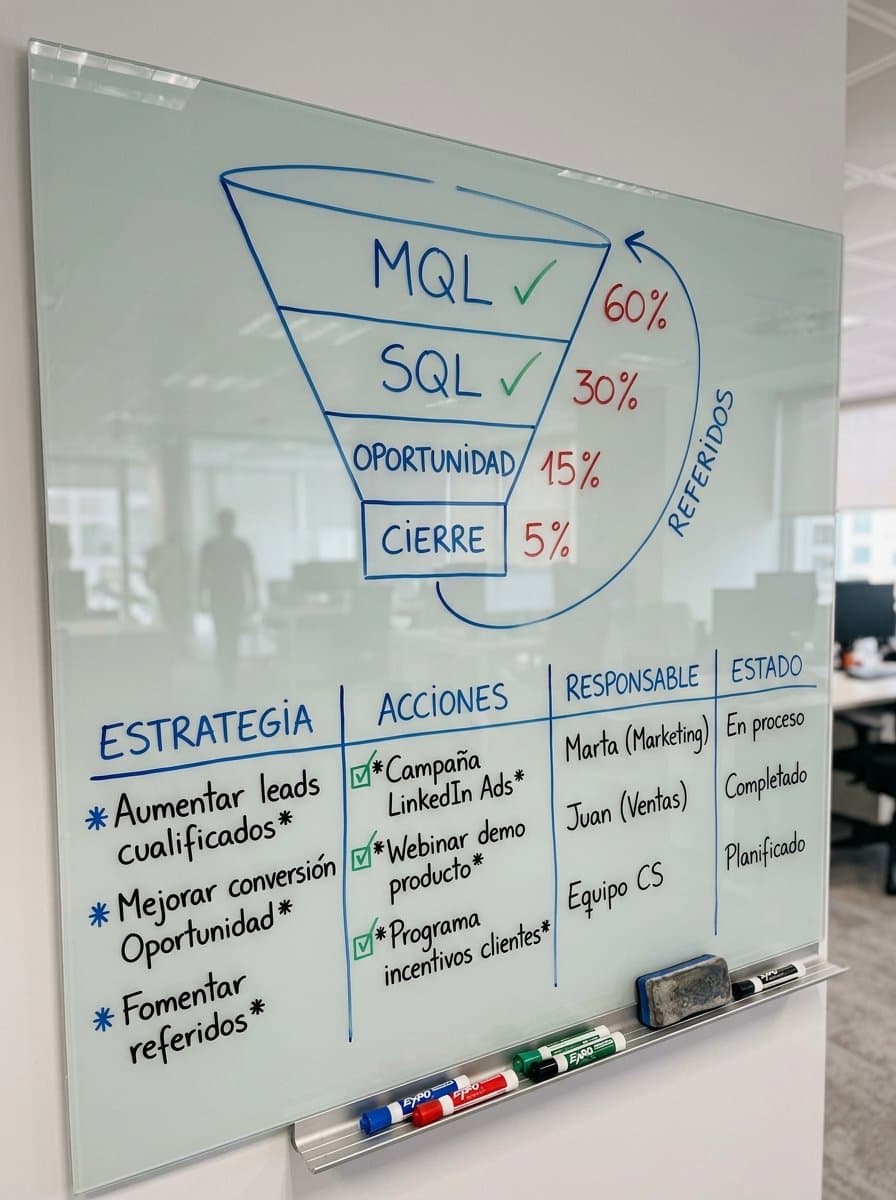
Recommended 2026 stack: Sales Navigator + generative AI + CRM
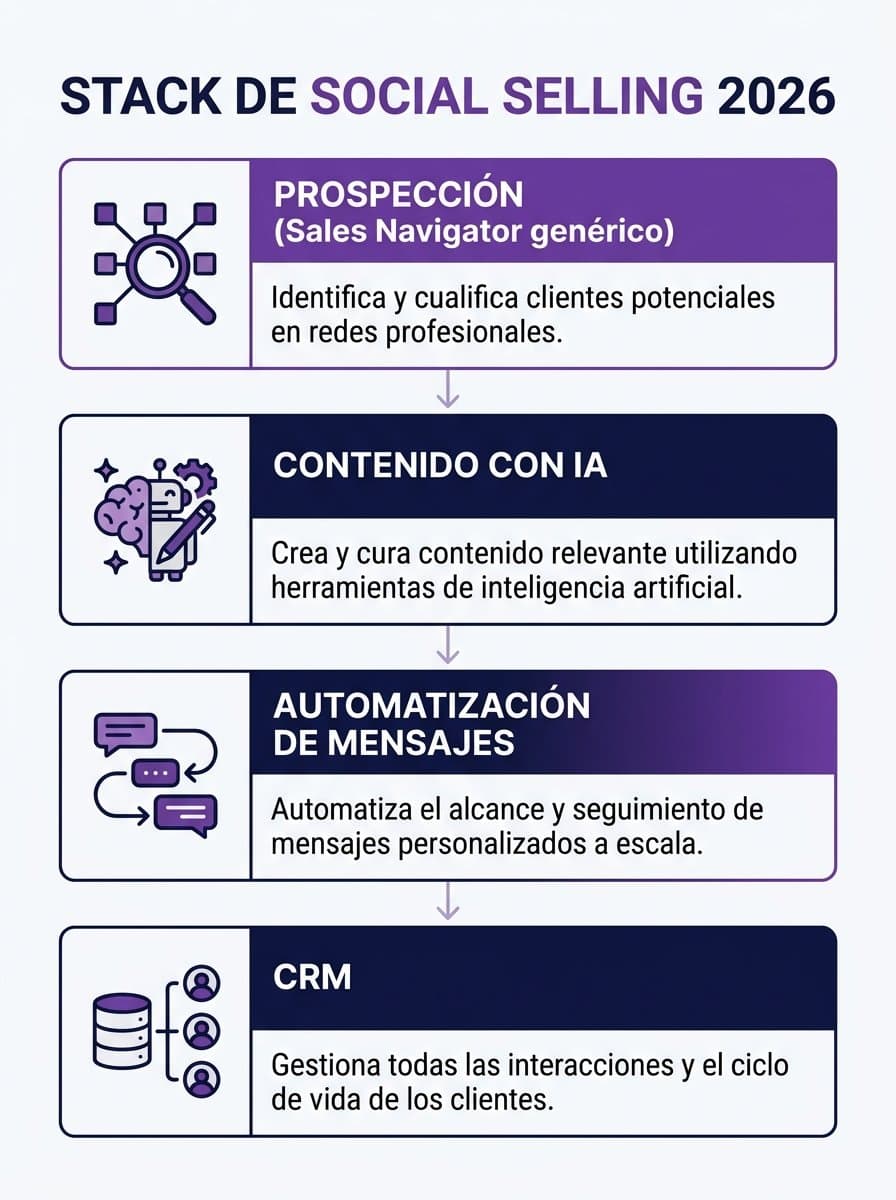
The base architecture for an effective social selling stack in 2026 has three layers. The first is Sales Navigatorfor account and contact intelligence. It's not cheap (the Team plan runs about $150/month per user), but the return justifies the cost if the process is well defined. Job-change alerts, saved searches by segment, and buyer intent filters don't have a free equivalent with the same data quality. Native integration with Salesforce and HubSpot saves hours of manual sync.
The second layer is generative AIfor content and messages. The stack varies by use case: a tool specialized in LinkedIn content like Clonio for weekly posts, and a general-purpose LLM (Claude, GPT-4o) for drafting message variants from the signals you pull out of Sales Navigator. The point is that AI doesn't replace the rep's voice; it scales it without losing coherence.
The third layer is the CRMas the qualification core. HubSpot Sales Hub or Salesforce handles cadence tracking, interaction history, and lead scoring. The temptation is to keep adding more tools (data enrichment, predictive scoring, engagement platforms) but the biggest mistake is building a stack nobody uses because it's too complex. Three well-integrated layers beat eight poorly connected ones.
Automated prospecting without burning your account
LinkedIn publishes loose guidelines but not exact limits, because it adjusts thresholds based on each account's history. The practical reference for 2026 is to stay under 100 invites per week on accounts with less than six months of active history, and below 150 on established accounts. Going over those numbers repeatedly triggers temporary restrictions that can last from 24 hours to several weeks.
The real risk isn't just volume, it's the pattern. Tools that run actions at regular, predictable intervals (say, exactly 10 invites every hour, every business day) are easy for LinkedIn's algorithms to spot. A more human cadence means variability: heavier days, lighter days, pauses on weekends, varied times. Tools that try to fake human behavior aggressively (fake mouse movements, artificial typing delays) are getting caught and penalized more and more.
The safer alternative is to work with tools that operate through LinkedIn's official API (like Sales Navigator with native integration) or that respect limits conservatively. If prospecting volume is high, it's better to spread it across several reps on the team than concentrate it on one. Also, invites with a personalized note have acceptance rates up to three times higher than blank invites, which means you need to send fewer to get the same result.
A lesser-known trick: actively posting content on LinkedIn buys you implicit headroom. Profiles that publish regularly and pull in organic engagement show legitimate usage patterns that lower the chance of being penalized for outreach activity. Content doesn't just generate direct leads; it also protects the account from restrictions by showing active, authentic platform use.
Cold messages with AI that don't look like mass copy-paste
The definitive test for a prospecting message is simple: could you have sent the exact same text to 200 people without changing a single word? If the answer is yes, the message is a generic template the recipient spots in two seconds. The three most effective signals for personalization are: recent job change (congratulate or ask about the first months in a new role), post engaged with (reference something specific they posted or interacted with), and company growth (mention a hire, expansion, or recent milestone visible on LinkedIn).
AI lets you generate messages that fold in those signals at scale. The flow is: Sales Navigator surfaces the signal, AI drafts a message that fits it into your value proposition, the rep reviews, tweaks tone, and decides whether to send. Time per message drops from five minutes to under one. If you want to go deeper on keeping these messages in a human voice, the article on how to write LinkedIn posts that sound human covers the specific techniques.
An example of a message that works for a job change:
“Hi [Name], saw you've been three months in as VP of Sales at [Company]. The first ninety days in that role usually go to figuring out which processes to scale and which ones to break entirely. At [Your company] we help teams in that transition shape their prospecting stack before the team grows. Worth a short call to see if it makes sense?”
This message has a specific signal (recent role), shows understanding of the moment (the first 90 days), connects with a real problem (scaling processes), and has a clear, non-aggressive CTA. AI can generate twenty variations of this template in seconds; the rep picks the one that fits the account's tone best.
How to build pipeline with content (80% of reps ignore this)
Most B2B reps see content as a marketing job, not a sales job. It's the most expensive mistake in the modern process. When you post three times a week about your customers' challenges, the cases you've solved, and trends in your industry, you're building an audience of decision-makers who know you before you ever reach out. The lead that lands after seeing twelve of your posts isn't a cold lead: it's a warm lead with enough context to decide if they want to talk to you.
The three content types that generate the most pipeline for sales profiles are: case studies (how you solved a specific problem, with numbers if possible), lessons learned (your own mistakes or those of customers, with the takeaway), and industry opinions (taking a stance on trends or debates that positions you as someone with a real point of view). Bland, inoffensive content generates neither engagement nor pipeline. Opinions with substance do.
The minimum frequency to see pipeline results is three posts per week for at least eight straight weeks. Below that, the compounding effect doesn't have time to kick in. The main blocker isn't creativity, it's consistency under quota pressure. That's where content generation tools like the AI LinkedIn post generatorsolve the real problem: they don't inspire, they remove the blank-page friction so the rep publishes even on a heavy week.
Comparison: Waalaxy vs Lemlist vs LaGrowthMachine vs Clonio for content
The social selling tools market splits between multichannel outreach platforms and content-specialized platforms. They're different problems with different solutions. This table sums up the main differences:
| Tool | Main use | Approx. cost | Ban risk | Best for |
|---|---|---|---|---|
| Waalaxy | LinkedIn + email outreach automation | $45–$90/mo | Medium-high | SDR teams with high prospecting volume |
| Lemlist | Multichannel email + LinkedIn sequences | $65–$110/mo | Medium | Outreach with visual email personalization |
| LaGrowthMachine | Advanced multichannel workflows | $65–$165/mo | Medium | Growth teams with complex flows |
| Clonio | AI LinkedIn content with auto-publish | Announced at launch | Very low | Reps and founders who want pipeline from content |
The practical takeaway: if your process depends mostly on direct outreach, the first three options cover that use case. If you want to build a system where content generates inbound leads and reduces dependence on cold outreach, Clonio is the specific option. They're not mutually exclusive; lots of teams run both layers in parallel.
Metrics that actually matter (and which ones to ignore)
The main problem when measuring social selling is the temptation to use easy-to-grab metrics instead of metrics that reflect real progress toward close. Impressions and total connection count are comfortable to report but don't predict revenue. The focus should be on metrics that connect activity to pipeline.
Metrics that matter:
- Qualified replies per week: conversations that move past the first exchange.
- Demos or calls booked: the critical step in the sales process that content and outreach need to feed.
- Opportunities created: leads entering the CRM with enough qualification to work.
- SQL ratio: percentage of LinkedIn leads that turn into Sales Qualified Leads. A low ratio points to segmentation or messaging problems; a high ratio validates the process.
- Pipeline from content vs outreach: separating these sources tells you where to invest more time.
Metrics you can ignore (or check only occasionally):
- Total connections: having 5,000 connections without engagement isn't worth as much as 500 highly active ones in your niche.
- Raw impressions: a viral post on a topic irrelevant to your ICP doesn't generate pipeline.
- Invitation acceptance rate: useful for tuning the invite message, but not a business metric.
- Profile views: an indicator of visibility, not qualified interest.
Classic mistakes that burn your account
- Using aggressive automation tools without configured limits. The time saved doesn't make up for a restriction that locks you out of LinkedIn for weeks in the middle of a campaign.
- Sending the same template to everyone. Lack of personalization is spotted instantly by recipients and destroys reply rates. AI should generate variations, not clones.
- Posting content without a point of view. Sharing news or reposting without adding your take doesn't build authority or start conversations. A clear point of view, even a divisive one, is what separates a creator from a curator.
- Ignoring Sales Navigator signals. Paying for the tool and using it only as an advanced search wastes 80% of its value. Job-change alerts and activity notifications are the intelligence layer that separates timely outreach from random outreach.
- Not integrating the CRM from day one. Tracking in spreadsheets or in your head doesn't scale. Every LinkedIn conversation should be logged in the CRM with date, context, and the next step.
- Quitting before the process matures. Content-driven social selling takes six to twelve weeks to generate sustainable pipeline. Reps who quit at three weeks because “it doesn't work” never reach the inflection point where the system starts feeding itself.
Frequently asked questions
How much daily time does an effective social selling strategy take?
Between 45 and 90 minutes a day in the early phase, split between posting content, reviewing signals in Sales Navigator, personalizing messages, and follow-up in the CRM. With a well-configured stack and AI for content, that time can drop to 30 to 45 minutes once you hit cruising speed. What doesn't scale is manual personalization of every message; that's where AI has the biggest impact.
Is Sales Navigator mandatory or are there alternatives?
Not strictly mandatory, but its data quality is hard to replicate with free tools. LinkedIn Premium Business covers some basic use cases. Apollo.io and Hunter.io add contact data on top of search. For teams with limited budget, starting with LinkedIn's free advanced search plus active content is a valid baseline. Sales Navigator pays for itself when prospecting volume is high and average deal size can absorb the cost.
Is it ethical to use AI for personalizing prospecting messages?
Outreach ethics don't depend on the tool, they depend on intent and outcome. If AI lets you send more relevant, less intrusive messages because the rep spends the time saved on better targeting, the result is better for the recipient. The ethical problem shows up when AI is used to scale contact volume without improving relevance, turning the process into automated spam with better grammar. The question to ask before every message: does this person have a real problem I can solve?
Wrap-up
Social selling in 2026 is a precision discipline, not a volume game. The four pillars (brand, signals, conversation, cadence) work together or they don't work at all. AI speeds up execution across all of them, but the judgment on who to contact, when, and with what angle is still on the rep. If you want to go deeper on keeping authenticity while scaling automation, the article on how to automate LinkedIn without losing authenticity covers the practical limits. And if consistent posting is your bottleneck, the guide on the best times to post on LinkedInwill help you maximize the reach of the content you're already creating.
Content is 80% of a modern pipeline.
Clonio posts for you what your decision-makers want to read. AI + your voice + auto schedule.
Get started